Dynamic Souq
An open-air retail complex shaped by CFD-driven design optimisation, extending its usable season from 40% to 58% of the year.
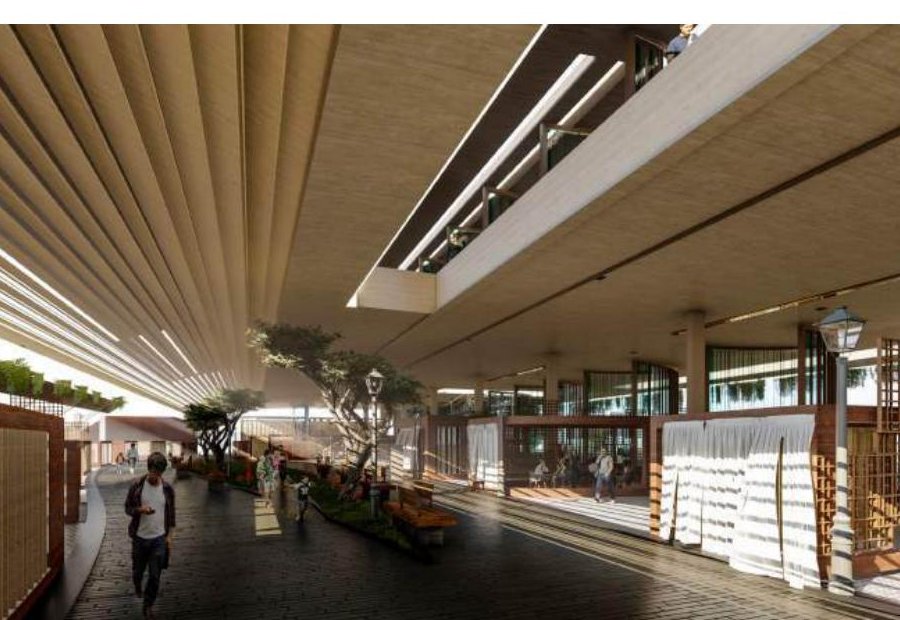
Outdoor commercial complexes in the UAE work for about five months a year. From November to March they're crowded; the rest of the year, they're abandoned to the heat. Effectively, the construction cost is paid for by half the calendar.
The brief was to extend that calendar. Working with my professors Vittorino Belpoliti and Hasim Altan, I ran the project as an iterative Computational Fluid Dynamics study, every massing decision was tested for its effect on wind speed at body height, then redrawn. The form is not the result of a sketch; it's the result of forty simulations.
From bar to buffer


The first row of shops became a wind blender. Curving each unit turned obstacles into deflectors; air arrived at the central spine smoothed and accelerated.


What CFD changed
Each iteration was tested in Autodesk Flow Design. Linear masses created turbulent wakes; curved masses deflected and channeled. Splitting the roof in two, a sloped upper canopy and a horizontal lower one, created a Venturi effect that pulled cooler air across pedestrian level.
Final result: average air velocity at body height rose from 4 m/s to 6–8 m/s, and overall ventilation efficiency from 52% to 78%. The complex stayed comfortably usable from late October through to mid-April, about 18% more revenue days than a comparable conventional layout.